Quick answer: An upstairs hotter than downstairs is physics before it is a malfunction. Heat rises, a 130-degree attic sits on your second-floor ceilings, and the ducts feeding those rooms cross that attic before the air reaches a register. Start with what costs nothing: open every upstairs register, ease two or three downstairs registers halfway shut, switch the thermostat fan to ON, and put in a clean filter. If the floors still read 5 degrees apart, the cause is usually leaky or under-insulated attic ductwork, or a second floor with no return air of its own.
Climb the stairs in almost any newer two-story in Frisco on a mid-August afternoon and you can feel the change around the fourth step. The living room reads 73. The game room over the garage reads 81, the west-facing bedroom beside it is worse, and the AC has been running since ten that morning without closing the gap.
That rarely means the equipment is failing. It means one system with one thermostat is being asked to hold two climates stacked on top of each other, and the upper one has a 130-degree attic pressing down on it all day. Most come within a few degrees of even, plenty without new equipment.
Upstairs Hotter Than Downstairs Is Physics, Not a Broken AC
Warm air rises and cool air falls, so the second floor starts every afternoon at a disadvantage before the AC gets a vote. Then there's the attic. Texas attics routinely push past 130 degrees in July and August, and that heat sits on your second-floor ceilings, radiating down through the drywall long after the sun leaves the roof.
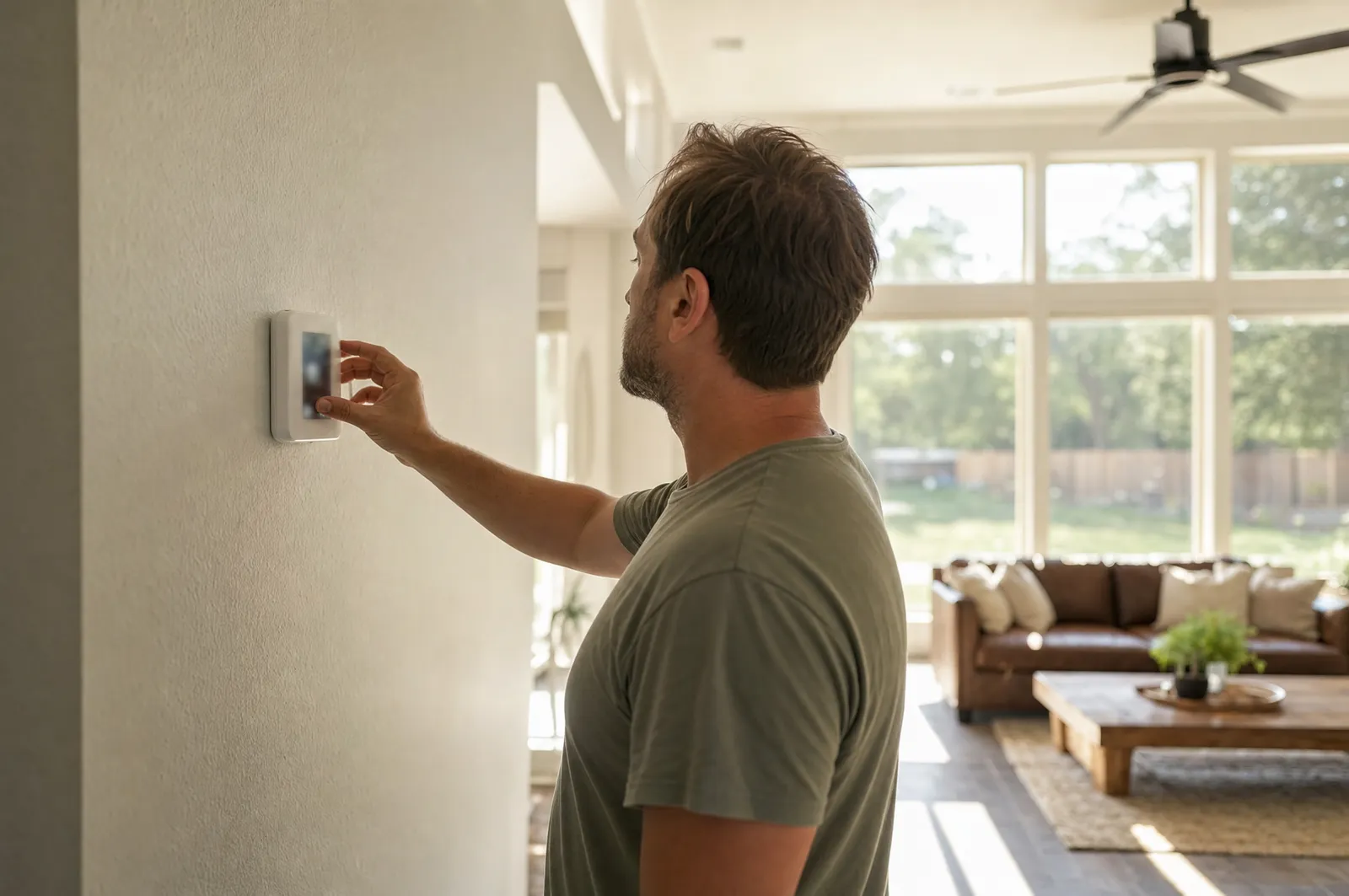
The thermostat compounds it. Most single-system two-stories have exactly one, mounted downstairs in a hallway. The second that sensor reads 72, the system shuts down, whether or not the bedrooms above it ever caught up. The equipment isn't broken. It's taking orders from the wrong floor.
Your Ducts Have Levers Nobody Has Touched Since the Builder Left
Most ductwork went in with manual balancing dampers, either a lever on the attic trunk line or one at the register itself. They are how the system was meant to be balanced, and in the average house nobody has moved one since the drywall went up.
For cooling season, open every upstairs register all the way, then ease two or three downstairs registers about halfway shut. Never close one completely and never choke off more than a handful: restricting too much air drives up static pressure, strains the blower, and can ice the indoor coil. You're steering air, not damming it.
Two to three degrees between floors is normal, even in a healthy house. If dampers get you to four and stall there, what's left is in the ducts, the returns, or the heat load itself.
Flip the Fan From AUTO to ON for the Worst of the Afternoon
On AUTO, the blower runs only while the compressor is cooling, and between cycles the house quietly separates back into two temperatures. Leave it on ON and the blower keeps circulating, pulling hot air off the second floor and mixing it with cooler air downstairs even when nothing is cooling. It's the closest thing to free zoning you own.
It isn't free, exactly. A blower running around the clock adds a little to the electric bill, and on humid days it can re-evaporate moisture off a wet coil back into the house. Run it through the afternoon rather than nonstop, and pick your setpoint with our guide to thermostat settings for a Texas summer.
A Dirty Filter Starves the Farthest Rooms First
A clogged filter chokes airflow at the source, and the rooms farthest down the duct system feel it first. That's always upstairs. Downstairs vents sit close to the air handler and keep taking their share while the second floor quietly gives up. Check the filter monthly through cooling season: a system running most of every day since May grays one out long before the 90 days printed on the sleeve.
Ducts Losing Their Cool in a 130-Degree Attic
Air leaves the indoor coil around 55 to 60 degrees, then crosses the house through an attic at 130. Every unsealed seam, crushed run of flex duct, and bare patch where the insulation slid off is a place for that gap to close, and the runs feeding the second floor spend longest in that heat.
ENERGY STAR puts the loss in a typical home at 20 to 30 percent of the air moving through the duct system, gone to leaks, holes, and joints that were never properly connected. In a two-story, most of that happens overhead, upstream of the rooms that already needed the most help.
Sealing seams with mastic, replacing crushed runs, and getting insulation back on the trunk lines is unglamorous work, and for a stubborn second floor it is usually the biggest single move available. A technician reading static pressure and temperature split during an AC tune-up can tell you quickly whether the ducts are your bottleneck.
Air Has to Get Back Downstairs Somehow
Supply is only half the loop. Whatever the system pushes into a bedroom has to find its way back to the air handler, and plenty of two-stories were built with one central return downstairs and none at all upstairs. Close the doors at bedtime and those rooms have no return path worth the name.
Those closed rooms go slightly positive and start leaking. Conditioned air presses out through attic hatches, recessed can lights, and gaps in the ceiling plane, and the house pulls hot makeup air back in elsewhere to balance the books. It's why some upstairs bedrooms genuinely feel worse with the door shut.
A return grille upstairs, a transfer duct, or jumper ducts over the bedroom doors give that air a legal way home and take strain off the whole system. On a house with a five-degree spread it's frequently the piece that was missing all along, and it joins the rest of the usual suspects in our guide to common Dallas AC problems.
Ceiling Fans Cool People, Not Rooms
A ceiling fan will not drop a room's temperature by a single degree. It works on you instead, moving air across your skin so sweat evaporates faster, which is most of what an overheated bedroom needs at nine at night. The Department of Energy credits a properly running fan with keeping most people comfortable at a thermostat setting about four degrees higher.
Run it counterclockwise in summer so it pushes air down at you, and switch it off when the room empties, because a fan running in an empty room is a small space heater with good intentions. For bonus rooms and bedrooms that never got one, adding a ceiling fan is the cheapest comfort upgrade here.
When One System Can't Do Two Jobs
Sometimes the honest answer is that one system and one thermostat were never going to hold two climates evenly. Think of the tall new builds where a bonus room sits over the garage and a two-story entry sends conditioned air straight up, away from the people paying for it.
Zoning splits the ductwork into sections, each with its own motorized damper and thermostat, so the system can throw most of its air upstairs at four in the afternoon and ease off once that floor catches up. We see the need for it constantly in Celina, where sprawling two-stories go up on a single system sized for total square footage rather than two floors with different heat loads.
For the biggest houses, or layouts where the trunk line cannot move enough air upstairs no matter how it's damped, a dedicated second system is the more reliable long-term answer. Which way to go depends on your duct layout, and that's a conversation to have with someone standing in your attic.
Make the Top of the Stairs Livable Again
An upstairs you avoid from June to September isn't something to plan your house around. Book from the calendar on this page, send us the details online, or call 972-421-8000, and we'll walk the attic, read the air at your registers, and tell you which of these fixes your house actually needs. Free call-out, free diagnostic, pricing published upfront, and 30+ years of doing this across the metroplex.