Quick answer: AC running but house still hot? On the worst afternoons of a Texas summer that's usually physics, not a fault. Residential equipment is sized against a design day near 100 degrees and about a 20-degree spread between outdoor and indoor air, and it gives up capacity with every degree past that, so at 105 a healthy system can run nonstop and still sit several degrees above your setting. What isn't normal is a house that loses ground hour after hour: a clogged filter, a matted condenser, ducts bleeding into a 140-degree attic, low refrigerant, or a system that has aged out. Work them in that order, or book AC repair.
Your system started before sunrise and it hasn't rested since. It's four in the afternoon, the thermostat reads 79, you asked for 74 before lunch, and the air at the vents feels cool without ever feeling cold. By the third day of that you start wondering whether something actually broke, or whether this is just what a 105-degree Tuesday does to an air conditioner in North Texas.
The line between those two is sharper than it looks from the couch. A system running flat out and holding within a few degrees of the setting is doing the job it was engineered to do. One running flat out and sliding backward, 79 this hour, 81 the next, 83 by dinner, has something specific wrong. There are about five somethings, and technicians work them in order for the same reason a mechanic checks the gas gauge first: the cheapest cause is the most common one.
AC Running but House Still Hot? Blame the Design Day
No central system sold in North Texas is built for the worst hour on record. It's sized against a design day, and for Dallas-Fort Worth that number lands right around 100 degrees. Somebody runs the load calculation and picks equipment that can hold your house roughly 20 degrees below the outdoor air on that day. Call it 80 inside when it's 100 out, with margin to spare through the mid-to-upper 90s of an ordinary August.
Then the thermometer clears that number, which DFW manages most summers, and capacity doesn't hold steady up there. A condenser sheds its heat into the air around it, so the hotter that air gets the less of it will move, and output falls off by roughly a percent for every degree past design. At 105 your unit delivers noticeably less than its sticker promises at the exact hour the house wants more, and the compressor stops cycling because there's nothing left in reserve. Sitting three or four degrees above your setting on that afternoon isn't a failure. It's arithmetic.
A Month-Old Filter in July Is an Old Filter
The filter is the cheapest thing to rule out and the first thing everybody forgets. Packed with dust and pet hair it strangles airflow across the indoor coil, and a coil with nothing moving over it can't pull heat out of your house no matter how hard the compressor works outside.
Pull it and hold it up to a light. If light won't come through it, neither will much air. With the blower running twelve hours a day in July, 30 days is the honest interval, whatever the box says about 90.
Cottonwood and Grass Clippings Insulate a Condenser
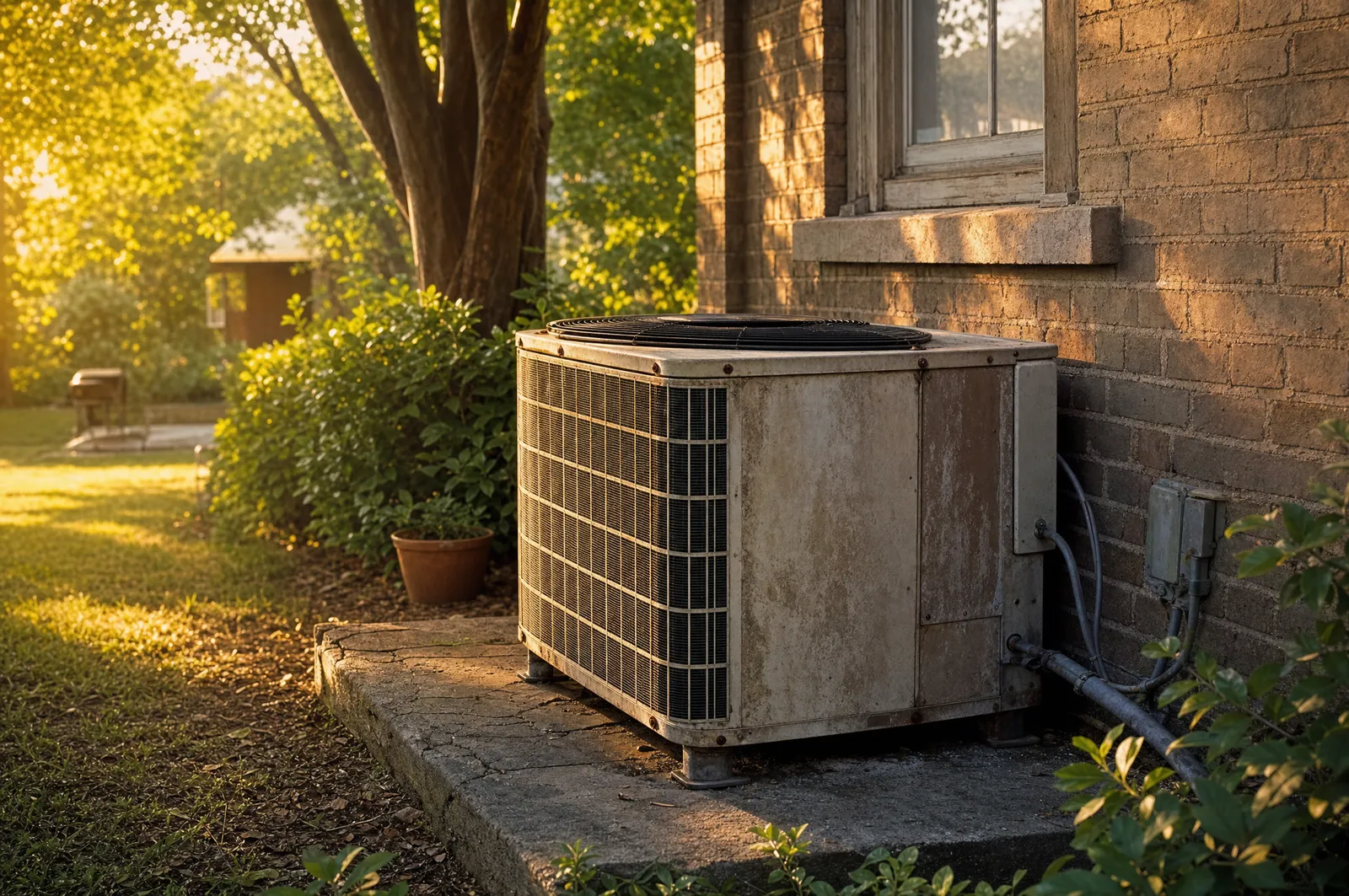
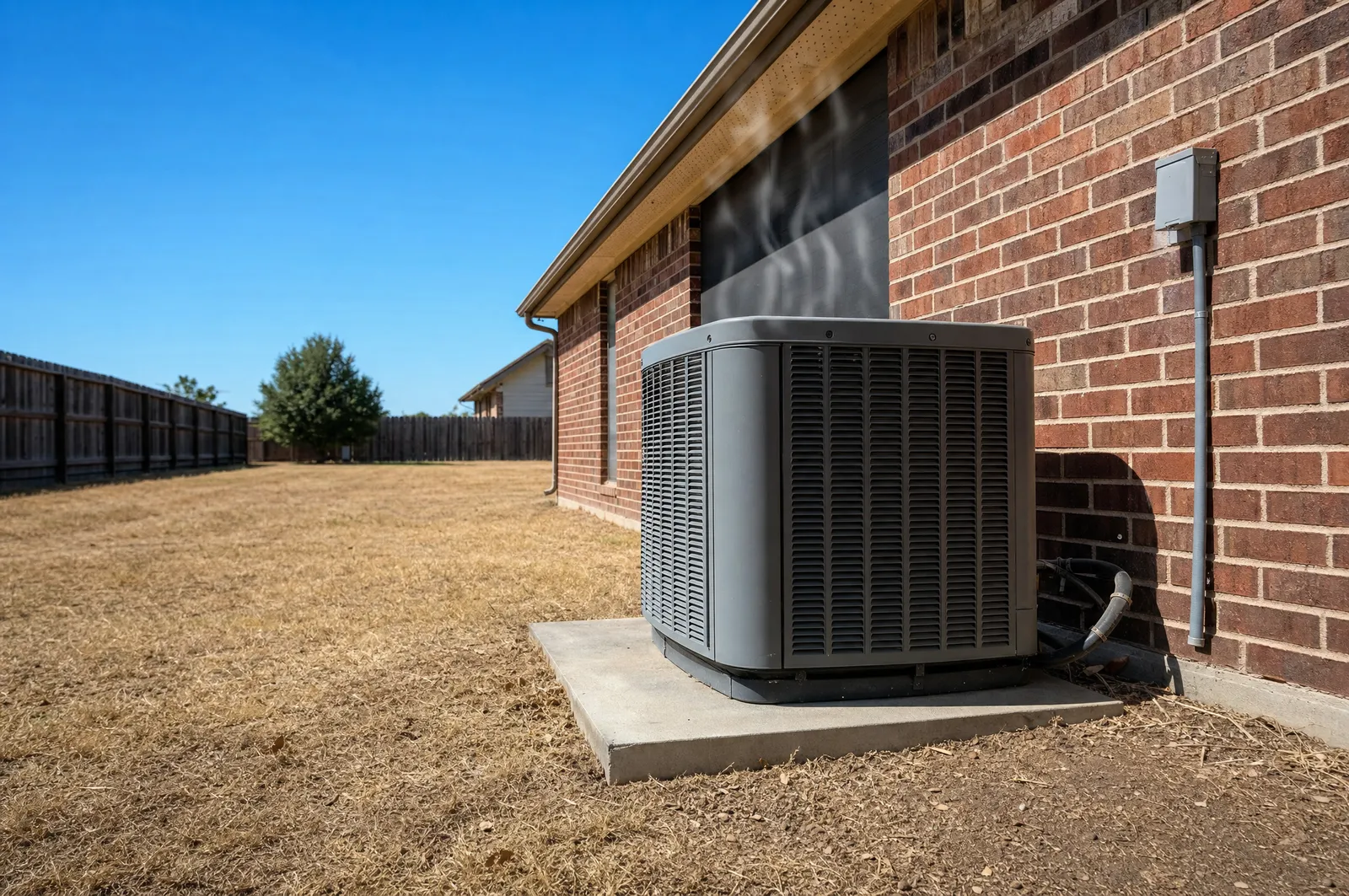
The outdoor unit has one job: take the heat it collected from your living room and hand it to the outside air. It does that by pulling air across a coil, and by late July that coil has been breathing cottonwood fluff, clippings from every Saturday mow, and a season of road dust. Matted over, it stops working like a radiator and starts working like a blanket, right when the system needs every bit it has.
Cut the power at the disconnect, rinse the fins from the inside out with a garden hose, and keep two feet of clearance on all sides. No pressure washer. The fins fold like foil, and they don't unfold.
You May Be Air Conditioning the Attic
Plenty of the homes we service in Mesquite and the older neighborhoods around it run every supply duct through the attic, and a North Texas attic in late July sits between 130 and 150 degrees. ENERGY STAR puts typical duct losses at 20 to 30 percent of the air moving through the system. That air doesn't disappear. It goes into the insulation, the framing, and the oven above your ceiling, and you paid to cool every cubic foot of it.
The tell is cooling that doesn't match the effort. Back bedrooms lag every afternoon while the front of the house holds fine, the registers whisper while the blower is roaring, the hallway under the main duct run stays warm however long the system grinds. Pressure testing the runs and sealing what's leaking is what duct repair is for, and it buys back more comfort than anything you can do to the equipment outside.
A Slow Leak Shows Up in the Afternoon First
Refrigerant isn't a consumable. It circulates in a sealed loop, so a system that's low is a system that's leaking, and every ounce that got out is cooling capacity you already paid for drifting off into the sky.
A slow leak keeps a schedule, which is why it hides so well in August: the house holds fine through the morning, then falls behind once the sun gets on the roof and the shrinking capacity runs out of room. Listen for hissing at the indoor unit and frost creeping along the copper line outside. Air that has gone past lukewarm to genuinely warm is a different problem with a different fix, and we covered an AC that blows warm air separately. The repair here is finding the leak, not topping off the charge every June.
Old Equipment, or a House That Outgrew It
Capacity fades with age even on a system that never missed a tune-up. Compressors wear, coils foul where a garden hose will never reach, and the unit that held 72 without complaining ten summers ago comes up three degrees short in its last few seasons. Nothing is broken, exactly. It's tired.
The other version is a house that grew out from under its air conditioner. We run into that constantly in Garland, where a garage conversion or an enclosed patio quietly added a few hundred square feet of load and nobody recalculated the tonnage. Both look identical from the living room: fine in May, fine in October, underwater whenever the high clears the mid-90s. If your system is pushing 15 years and still can't hold the line, a correctly sized AC replacement beats a fourth repair. We'll run the numbers with you either way, and we'll say so plainly when the repair is the smarter buy.
Normal for August, or Time to Call Someone
Fresh filter, clean coils, no ice, no new noises, no bill that doubled overnight, and DFW running past 100 all week? You're most likely watching a healthy system lose a fair fight with the weather. Let it work through the worst of the afternoon and look again at nine that night, once the sun is off the roof and a healthy system starts taking back degrees.
Call it in when the house loses ground day over day instead of just between noon and seven, when the copper lines or the outdoor coil ice over, or when the system won't cycle off at two in the morning with 82 degrees outside. Our guide to common Dallas AC problems covers the wider list, and a spring AC tune-up catches most of what's on this page months before the heat can expose it.
One Visit Beats a Week of Wondering
You can book straight off the calendar on this page, reach us through contact us online, or call 972-421-8000 and talk to somebody who has run this call in this heat. The trip, the diagnosis, and the estimate are all free, the pricing is published online before you approve anything, and you'll get a straight answer about whether this is an ordinary 105-degree afternoon or a system that's finally finished. Stork's has walked DFW households through 30-plus of these summers.