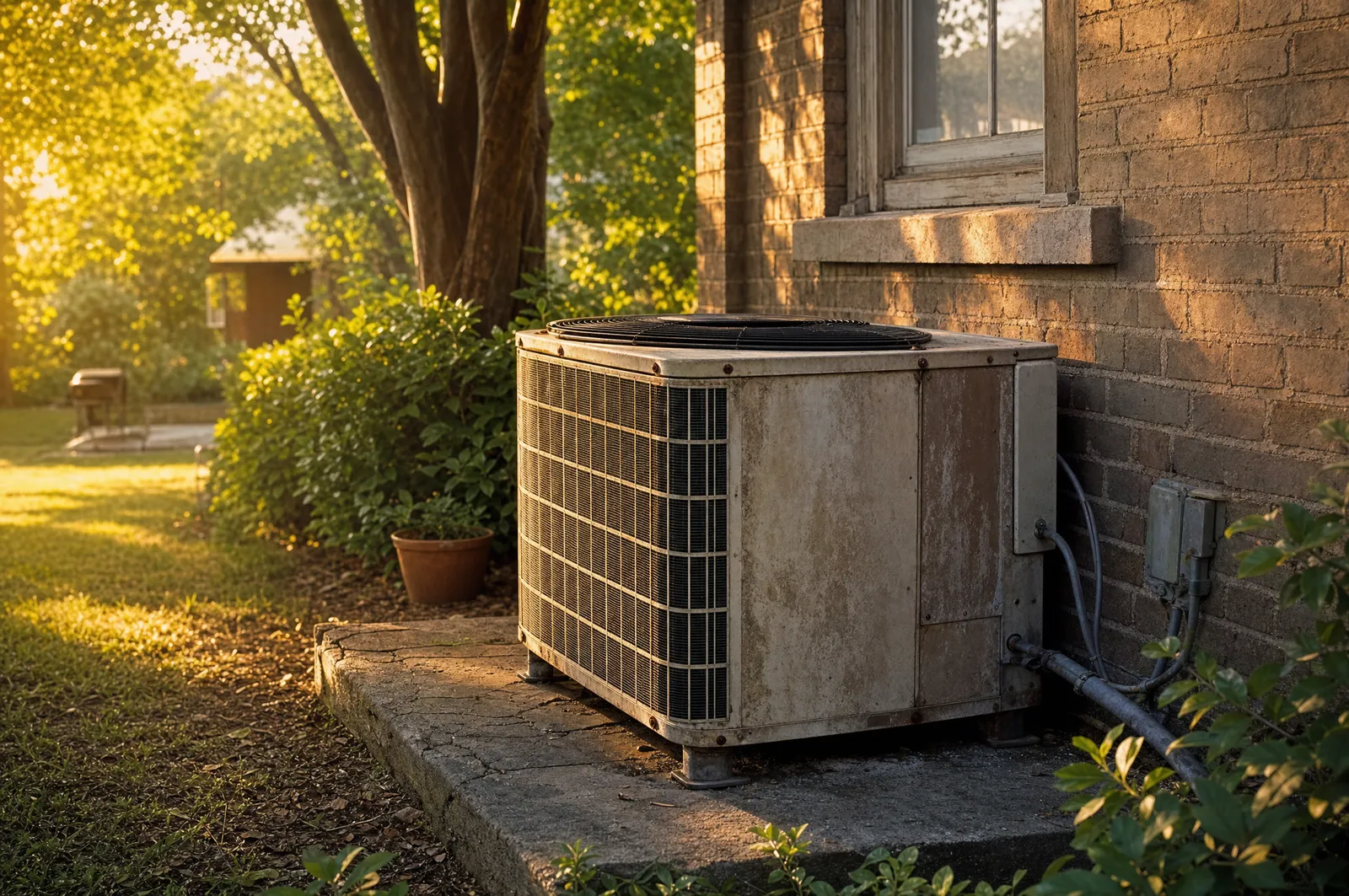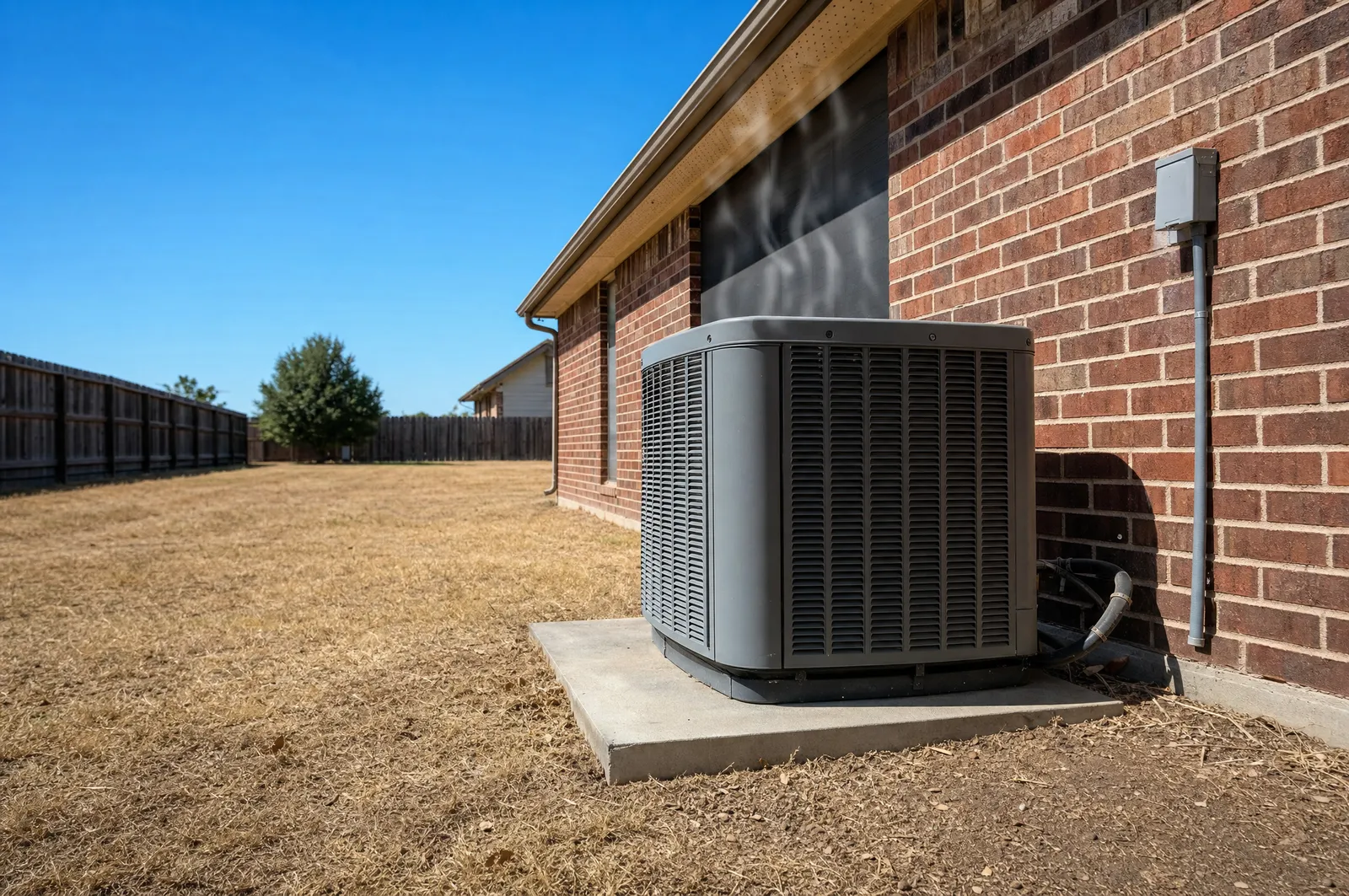
Quick answer: An AC leaking water almost always means a clogged condensate drain line. A Texas air conditioner wrings 5 to 20 gallons of water out of humid air on a hot day, all of it leaving through one three-quarter-inch pipe, so it takes very little algae to back that water into a pan, a ceiling, or a float switch that shuts everything down. Check the secondary pan, flush the line with white vinegar, and call for AC repair if the water keeps coming back. The diagnosis costs you nothing.
You notice it before you understand it. A soft brown ring on a hallway ceiling, or a puddle on the platform under the attic air handler, and nothing about the system sounds wrong. The compressor is running. The house is cooling. And yet there's water somewhere water has no business being.
Your air conditioner is a dehumidifier that happens to cool. Every gallon of moisture it pulls out of your air has to leave the house somehow, and most days it leaves quietly through a pipe you've never thought about. Then Gulf moisture parks over North Texas, dew points climb into the seventies, and that pipe moves more water in an afternoon than it usually moves in a week. That's when it clogs.
An AC Leaking Water Is a Plumbing Problem, Not a Cooling One
Cooling your house means dragging warm, humid air across a coil cold enough to sweat. Moisture condenses on it the way it beads up on a glass of iced tea on a patio table in July, drips into a shallow pan below, and runs out through a condensate line: three-quarter-inch PVC, thinner than the drain under your kitchen sink.
On a mild May day that's a gallon or two. On a sticky afternoon with the system running nearly nonstop, a Texas home can push 5 to 20 gallons through that line before bedtime. Twenty gallons is four five-gallon buckets, all of it draining through a pipe you could plug with your thumb. Algae does the rest, growing in the dark, wet pan until a slug of it slides into a line with no margin to spare.
The Drip Over Your Window Is the Backup Line Talking
Most systems run two drain paths. The primary line does the everyday work and ends somewhere boring, near the outdoor unit or tied into a plumbing drain, where a slow drip goes unnoticed for years. The secondary, or emergency, line is plumbed somewhere you can't miss it: above a window, over the front door, out through the soffit.
That's not sloppy installation. Code requires that discharge to land somewhere conspicuous, so the house tells on itself. In the newer additions around Forney, where whole streets came off the same set of builder plans, we can point out the emergency stub over the front window before we're out of the truck. If you find it dripping, or the brick beneath it stained, the primary line has already failed and the backup is covering for it. Treat that as a two-week notice, not a curiosity.
The Float Switch That Shuts Your AC Off On Purpose
Under the evaporator coil sits the primary drain pan. Under that, in the attic installations standard across newer North Texas homes, sits a secondary pan whose only job is catching what the first one missed. A float switch can ride in either pan or in the drain line itself: a small sensor that lifts with the water and breaks the low-voltage control circuit the moment the level turns serious.
That's why an AC can quit cold on a 100-degree afternoon with no bang, no burning smell, and no warning at all. Before you start pricing compressors, get a flashlight on that secondary pan. A tripped float switch isn't a failure. It's the cheapest insurance in your house doing exactly what it was installed to do, and clearing the clog behind it is usually the whole repair.
When the Ceiling Finds Out Before You Do
Not every system has a float switch, and plenty of older ones carry one that failed years ago or got bypassed during a repair. With nothing to stop it, water takes the shortest route down, and from an attic that route runs through drywall.
Out in Rockwall, where the newer neighborhoods off Lake Ray Hubbard put the air handler overhead, the first evidence of a two-dollar clog is often a brown ring over a bedroom. A stain under an attic unit is never a coincidence, and it's never as small as it looks, because drywall wicks a leak sideways long before it drips.
A Frozen Coil Turns Into a Flood the Moment You Shut It Off
A clogged drain isn't the only way an AC puts water on your floor. When restricted airflow or a low refrigerant charge lets the evaporator coil ice over, that coil holds more water, frozen, than the pan below was ever sized to catch. Shut the system down and the ice doesn't disappear. It melts faster than the line can carry it off, and you get the same ruined ceiling a clog would have given you.
The tell is what the air was doing before the water showed up. Weak airflow, air that's warm instead of cold, frost on the copper lines outside: that's a frozen AC unit, and mopping up is the easy part. The real question is why the coil froze.
Three Things You Can Safely Try Yourself
None of it involves refrigerant or high voltage, and any one can end the problem in an afternoon.
- Flush the line with white vinegar. Find the capped T-fitting on the line near the indoor unit, pull the cap, pour in a cup of plain distilled vinegar, and give it thirty minutes before you run the system again. Vinegar eats algae without going after the cemented joints or the metal pan the way bleach does.
- Put a wet-vac on the outdoor stub. Kill power to the system, seal a shop vac hose over the end of the drain line where it exits outside, and run it a minute or two to pull the clog out backward. Have a rag ready. When it lets go, it lets go all at once.
- Empty the secondary pan. If it's holding water, sponge it dry and clear what you can reach before you restart, or the float switch will trip again inside the hour.
The Point Where a Wet-Vac Won't Save You
Call us if the vinegar and the shop vac don't get the primary line dripping again, if the float switch keeps tripping after you've cleared what you can reach, or if a ceiling is already stained. Same answer for a line that plugs every summer no matter how faithfully you flush it: that pipe needs a real cleanout and a look at its slope, not more vinegar.
Nobody should be crawling the joists of a 130-degree attic in July chasing a clog they can't see. That's what a licensed AC technician is for, and with us the visit and the diagnosis are both free.
Ten Minutes in April, or a Drywall Crew in August
A clog is weeks in the making, exactly the kind of slow-moving problem a spring AC tune-up catches while it's still a nuisance. Flushing the line, testing the float switch, and looking in both pans is a few minutes of a technician's visit, and it's the difference between a wet rag and a repainted ceiling.
Our maintenance agreements fold that visit in and back the equipment with 10-year parts and 10-year labor warranties. For the wider picture of what a North Texas summer does to a hard-working system, our guide to Dallas AC problems runs the list.
Stop the Water Before It Costs You a Ceiling
Pick a time from the calendar on this page, send us the details online, or call 972-421-8000 and get a person instead of a phone tree. In peak season we can usually be out the same day. Free call-out, free diagnostic, and the price on the table before anyone opens a drain line. Thirty-plus years of North Texas summers have taught us that a leak is a clock, and the sooner we reach it, the less of your house it takes.