Quick answer: A real furnace tune-up is eight checks and the better part of an hour. The burners come out and get cleaned, the flame sensor gets scoured, the heat exchanger gets inspected and documented, manifold gas pressure gets read on a manometer rather than guessed from across the room, the blower and its capacitor get metered, every safety switch gets tripped on purpose, a combustion analyzer reads carbon monoxide off the flue as a number, and the filter gets handled on the way out. Book it before the first real cold front fills every HVAC calendar in DFW with no-heat calls.
Early November in North Texas is the quiet before the bill comes due. The mosquitoes have quit, the air conditioner is finally off the payroll, and DFW's average first freeze doesn't arrive until around November 22. Right now our technicians aren't stacked four deep behind heating repair calls, and the calendar on this page still has whatever day suits you. Two weeks from now, neither of those things is true.
Your furnace has probably already coughed to life once or twice, an hour on the back of an October norther, just long enough to convince you it works. That proves less than you'd think. A furnace will start on a 48-degree morning with a flame sensor it can barely read and a capacitor well under its rating. What it won't do is run flat out from midnight to sunrise the first time the thermometer drops to 28. The end-of-summer AC tune-up we talked you into back in September has a winter twin, and this is it.
Somebody Has to Pull the Burners
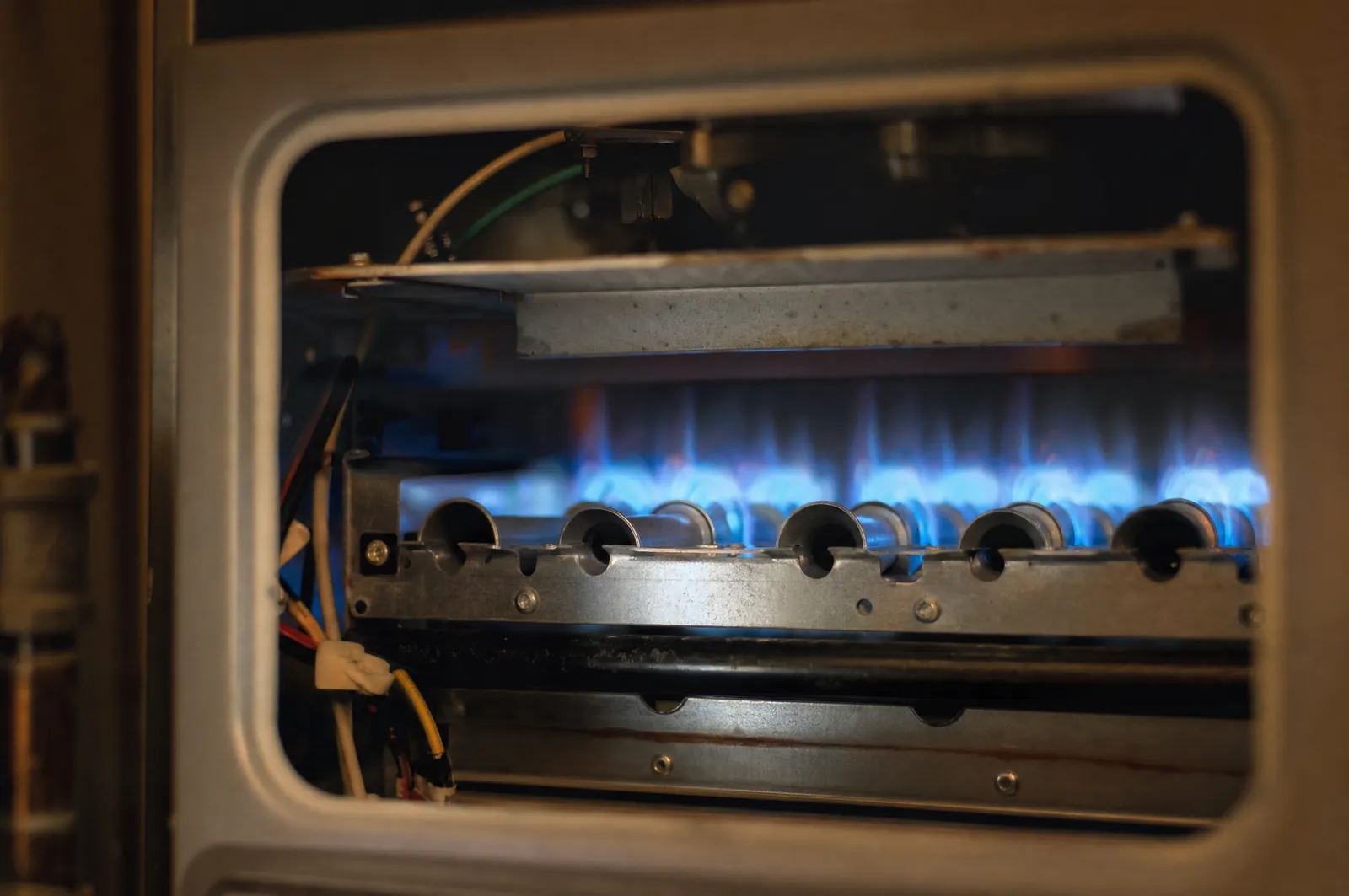
The burner assembly comes out and gets cleaned of a summer's worth of dust and rust scale. A dirty burner runs lazy and yellow, throwing a spiky, wandering flame instead of the tight blue cone it should hold. The igniter gets inspected for hairline cracks and a weak, orange glow, then the whole sequence gets cycled several times, because one successful light means nothing. A furnace that clicks three times before it catches is already telling you something. Better to hear that in November than discover it in January.
The Flame Sensor Is a Five-Minute Job Nobody Does
The flame sensor is a thin metal rod sitting directly in the burner flame, there to prove to the control board that there is actually fire in there. It does this by passing a current measured in millionths of an amp through the flame itself. A signal that small is trivially easy to block. Every hour the furnace runs leaves residue on that rod, and combustion air carries household dust in with it, until a film too thin to see insulates it completely.
The board then reads no flame with fire six inches away, and shuts the gas valve for safety. That is the classic furnace that fires for four seconds, drops out, retries, and finally locks out entirely, always on the coldest night of the year. A pass with an emery cloth fixes it in five minutes. It only gets fixed if someone actually pulls the sensor and looks at it.
The Heat Exchanger, and the Photo You Should Insist On
The heat exchanger is the metal chamber that keeps combustion gases on one side and the air your blower pushes through the house on the other. A crack lets those two mix, and it is the one finding on this list that carries real danger: a furnace with a confirmed crack gets shut off, not nursed through one more winter. It is also the most abused diagnosis in this trade, so we'll say it plainly. Any technician who tells you your heat exchanger is cracked should be able to show you that crack on camera before you approve a dollar of work. If ours finds one, you'll see the footage, and we'll walk you through what you're looking at and what it becomes, which is a furnace repair conversation rather than a tune-up. No photo, no cracked heat exchanger.
Gas Pressure Is a Number, Not an Opinion
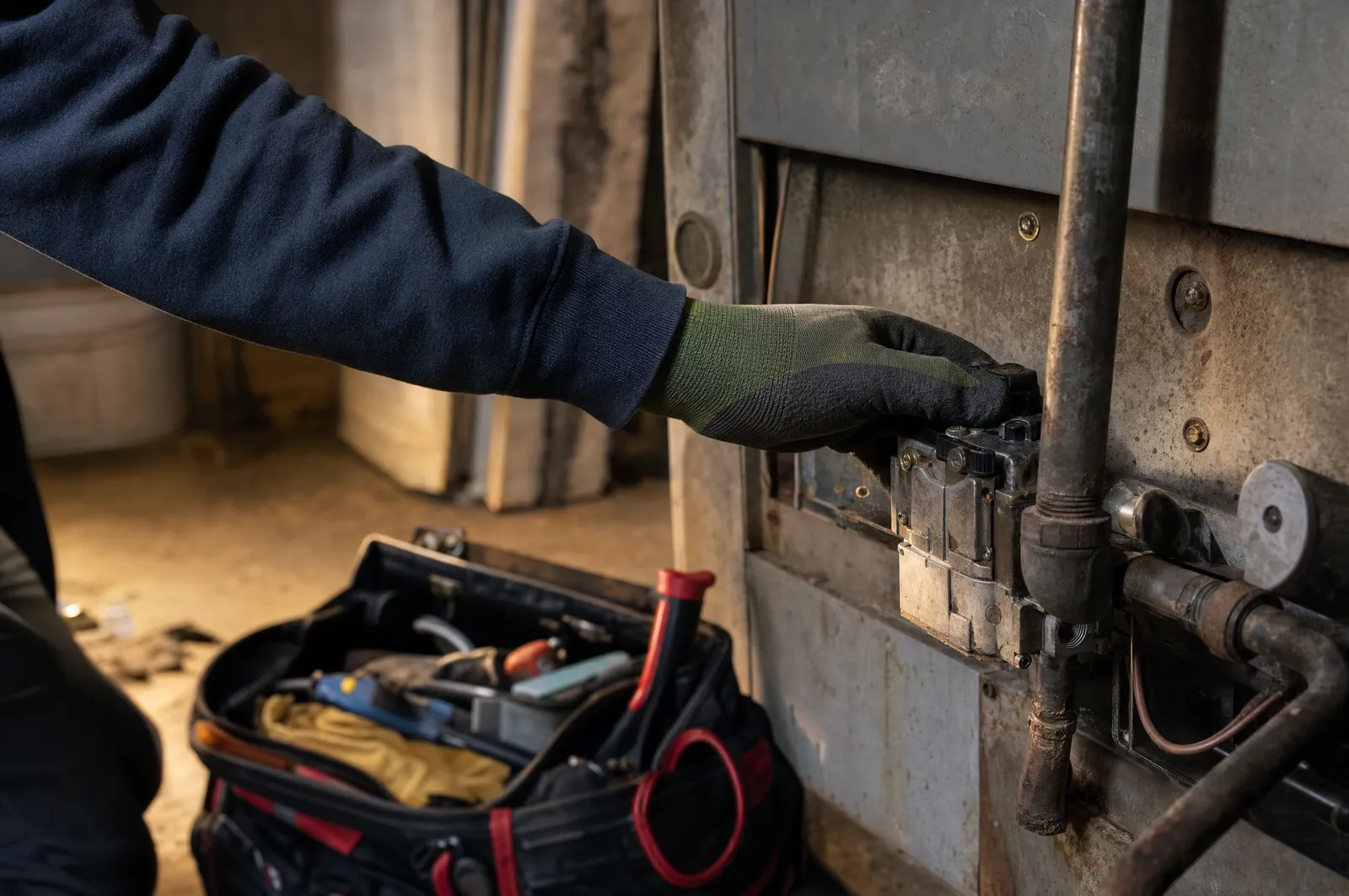
Manifold gas pressure gets read on a manometer, not judged by flame color from six feet back. Most natural gas furnaces want roughly 3.5 inches of water column. Run it high and you overfire the heat exchanger, shortening its life and tripping the high limit on the coldest nights, when you least want it dropping out. Run it low and you get rough ignition and incomplete combustion. Plenty of the older furnaces we service in Dallas have never had a gauge on them, not once in twenty winters, because the check costs ten minutes and sells nothing.
The Blower and the Capacitor Get a Meter on Them
The blower actually delivers the heat, and on most furnaces it's a PSC motor with a run capacitor wired in the whole time it spins. That capacitor gets measured against the microfarad rating printed on its can. One reading meaningfully under that number is a January failure with a date already on it, a twenty dollar part now versus an emergency call later. Newer variable-speed blowers use an ECM motor with no capacitor, so the check becomes amp draw and the control module. Either way it gets metered, and it matters most in the two-story Frisco houses where the blower already fights to push warm air upstairs. The filter gets checked while the panel is open, since a clogged one loads that motor from the other direction.
Safety Switches Only Count If They Actually Trip
Your furnace carries three or four switches whose whole purpose is to shut it down before something worse happens, and not one gives a sign it has quit until the night you need it. The limit switch kills the burners if the cabinet runs hotter than design, usually thanks to a choked filter or a fading blower. The rollout switch senses flame creeping out of the burner box instead of drawing back where it belongs, and cuts the gas. The pressure switch won't let gas light until the inducer proves it's pulling exhaust up the flue. A real tune-up confirms each one trips on demand, not merely that it exists.
Carbon Monoxide Gets a Reading, Not a Sniff
A combustion analyzer goes in the flue and returns an actual carbon monoxide number, which either sits where that furnace should be or it doesn't. Nobody can do this by smell, because carbon monoxide has none. It matters more in the tight new construction across McKinney, where a house trades far less air with the outdoors than a drafty 1970s ranch did.
One reading a year is not a substitute for alarms, though. You want a working CO detector on every level of the house and outside every sleeping area, tested, with batteries newer than last winter. If your furnace burns gas, that part isn't optional. And if an alarm ever sounds, get everyone outside first and call 911 from there. Don't stay inside hunting for the source.
What the $29 Special Leaves Out
A furnace tune-up priced under a tank of gas is a lead generator, not a service call, and it's the exact pattern our guide to choosing an HVAC company warns about. The eight checks above need a manometer, a meter, and a combustion analyzer, and real time with the panels off. Ten minutes and a new filter buys you exactly that, plus a quote for parts nobody showed you. And if your furnace already hesitates before it lights, or blows lukewarm for its first several minutes, you're past maintenance and into diagnosis. Our guide to furnace problems in Dallas covers what we find most once the cold sets in.
Book While the Calendar Still Has Room
The morning after the first freeze, every furnace in the metroplex with a tired capacitor decides to prove it at once, and the appointment you get is whatever we have left. Today you pick the day. Every check on this list is part of our standard furnace tune-up. Our maintenance agreements cover this visit and your spring AC tune-up together, both backed by 10-year parts and 10-year labor warranties. Grab a slot from the calendar on this page, get in touch online, or call 972-421-8000 and talk to somebody who's been doing this here for 30+ years. Upfront pricing and a real technician rather than a $29 drive-by.