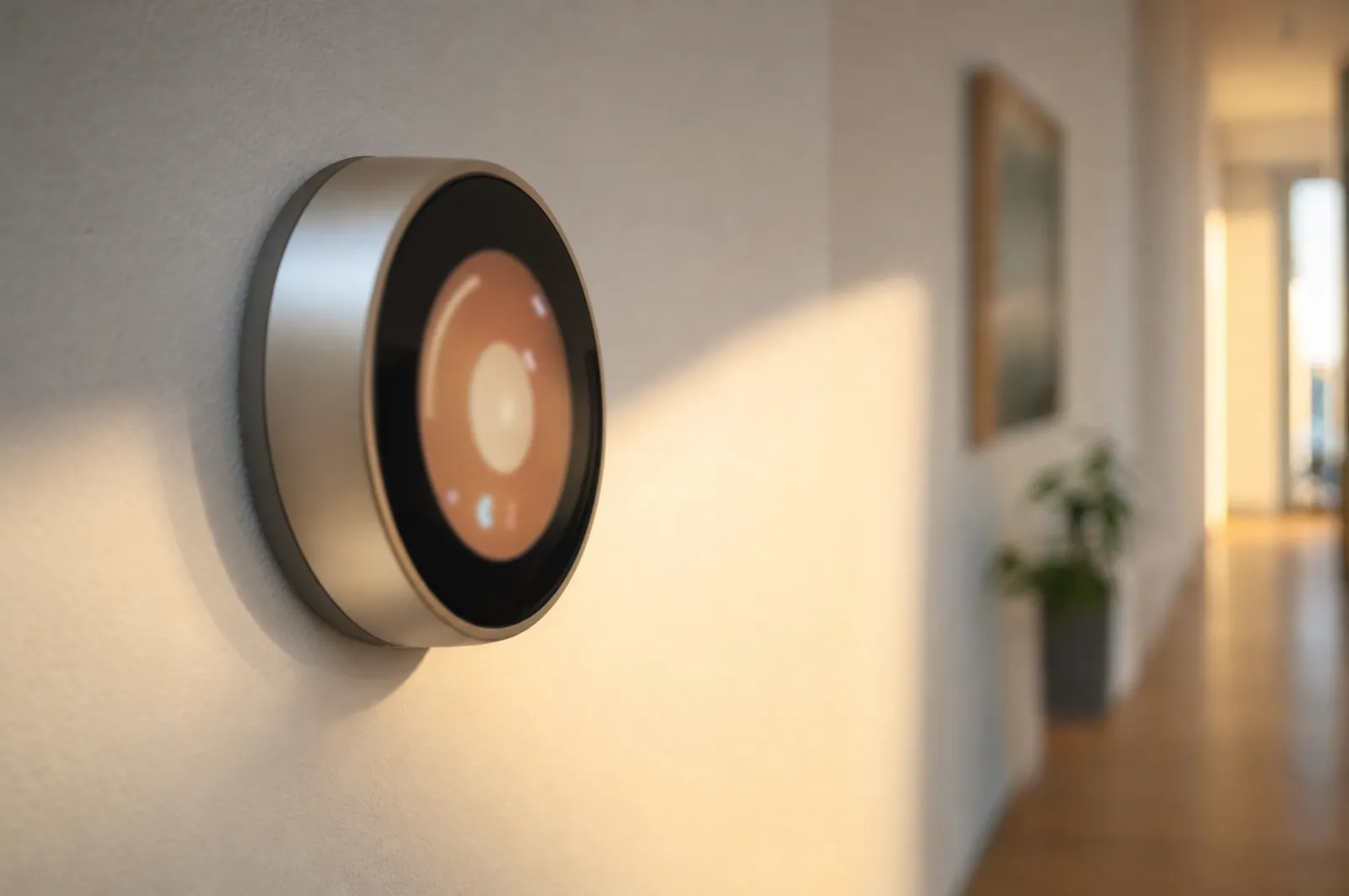
Quick answer: The best thermostat setting for a Texas fall is not a number, it's a mode. Put the system on auto so it changes over between heat and cool without you, then leave a real gap between the two setpoints: heat around 68, cool around 76 to 78, both gentler targets than what a Texas summer asks of a thermostat. Most thermostats will let you narrow that gap to about 2 degrees, and 2 degrees is how a house ends up running the furnace at breakfast and the AC after lunch. If yours won't hold either number, or changes modes on its own, that's hardware, not weather.
Every October, DFW runs the same trick on its own homeowners. Tuesday hits 88, the west-facing brick soaks it up all afternoon, and the AC cycles twice before lunch. Thursday morning the porch reads 51 and the furnace fires for the first time since March. Same house, same thermostat, two completely different jobs inside of 48 hours.
For eleven months of the year, a thermostat only has to be right about one thing. Fall makes it be right about both, sometimes before dinner, and that's where a lot of North Texas thermostats start behaving strangely. Nothing broke. Nobody ever told the system it was allowed to switch.
Auto Mode Is Built for the Week You're Having
Most homes run locked on cool from April through October and locked on heat from November through March, and for most of the year that's exactly right, because only one of them is ever true. October is the exception. Set the mode to auto, which some thermostats label auto changeover, and it reads the room and decides which side to call for. No flipping the switch Tuesday night and flipping it back Friday.
Heat pump homes already live here. A heat pump does both jobs with one outdoor unit, so auto changeover isn't a fall convenience, it's how the equipment expects to be run. It's the furnace-and-AC houses that spend the shoulder season switching by hand and losing.
The Deadband Is the Setting Nobody Ever Touches
What makes auto mode work is the deadband, the gap the thermostat insists on between your heat setpoint and your cool setpoint. Most units enforce a minimum around 2 degrees and plenty ship wider. Homeowners are the ones who close it.
Here's what closing it looks like. Heat at 70, cool at 72, and the house has a two-degree hallway to live in. The furnace warms the room to 70, the room keeps coasting the way rooms do, and at 72 the AC answers. Both halves of the system running inside the same hour over two degrees of drift, and the thermostat is doing precisely what you told it to.
Give it room instead. Heat at 68 and cool at 76 leaves eight degrees of dead space, which sounds like a lot right up until you watch an October afternoon here move 30 degrees between sunrise and four o'clock. The house drifts across that gap for hours and neither side has to say anything.
The Best Thermostat Setting for Fall, in Two Numbers
Heat at 68 while you're up and moving is the Department of Energy's long-standing number, and it holds here as well as anywhere colder. Drop it 7 to 10 degrees overnight and while the house is empty, and the DOE puts that at up to about 10 percent a year off heating. Fall is the cheap half of that trade: recovery costs almost nothing when the air outside is 55 instead of 25.
Cooling doesn't quit in October either, it just gets easy. A west-facing two-story in Allen will still call for AC on an 88-degree Tuesday, and 76 to 78 covers it now that the attic isn't parked at 130 degrees from noon to dusk. The number moves between July and October less because your comfort changed than because the outside air finally started doing work the compressor used to do alone.
The Open Windows Weeks Are the Cheapest of the Year
Somewhere in every DFW fall sits a stretch of two or three weeks when the thermostat has almost nothing to do. Highs in the upper 70s, lows in the 50s, a house that holds its own temperature most of the afternoon. Those weeks are worth catching on purpose.
Open the windows in the evening once the outside air drops below your setpoint and you're cooling the house on nothing. Shut them before the afternoon climbs back into the 80s and you keep it. This is August electric bill logic run backward: that bill is mostly compressor hours, so the hours you need neither compressor nor burner are the ones that show up in October. Out in Murphy, where the subdivisions went up fast enough that the trees still aren't taller than the rooflines, an open evening does work the shade can't.
The catch is ragweed. It's the headline North Texas fall allergen from late summer into November, and an open window is an open door for it. If somebody sneezes their way through October, keep the windows shut and let the blower and the filter do it.
The First Time the Furnace Runs Since March
Fall is also the week the heat side wakes up, and it doesn't always wake up quietly. That first burn of the season usually comes with a hot dust smell, which is exactly what it sounds like: a summer's worth of dust cooking off equipment that has sat idle since spring. It should thin out inside the hour and not come back.
What shouldn't get filed under normal is anything else. A sharp electrical smell, hot plastic, or burning that outlasts that first cycle is worth shutting the system down over before you run it again. If you smell gas, don't troubleshoot and don't hunt for the source: get out, call the gas company from outside, and sort out the heating repair after. October is also the month to hit the test button on the carbon monoxide detectors and replace the batteries in the ones that complain.
A Schedule Built for a Flat Week Falls Apart in a Swinging One
A programmable thermostat earns its money in exactly this weather, but only if the schedule was built for it. Wake 68, leave 62, home 68, sleep 62 is a perfectly good January program, because January mornings and afternoons want roughly the same thing. Run it now and Tuesday needs the cool side while Thursday needs the heat side, and a schedule that only knows one direction can't get there.
The fix isn't a more elaborate schedule. It's auto mode doing the switching, a deadband wide enough to keep the switching rare, and, if you have a learning thermostat, a week of leaving it alone. Those units time their own starts around how fast your house actually heats and cools, and a swing week teaches them the most.
When It's the Thermostat and Not the Weather
Fall exposes a marginal thermostat the way nothing else does. A unit reading two degrees warm since June hides it beautifully when the target never moves. Ask it to run both sides of the house inside 48 hours and the errors show up in daylight: heat running with the windows already open, the AC answering ten minutes behind the furnace, a display reading 70 in a room that is plainly not 70.
Most thermostats last 10 to 15 years, and the end of one looks a lot like ordinary fall confusion at first. It drifts off setpoint. It responds late. It sticks between modes. Before you blame the season, check the cheap two: fresh batteries, and whether it's mounted somewhere that lies to it, a wall with afternoon sun on it or a spot in the draft of a supply register. If those come back clean, swapping the thermostat is usually a shorter job than the week you'd spend arguing with it.
Two Seasons, One Thermostat, No Guessing
Book from the calendar on this page, send us a note online, or call 972-421-8000 and talk to somebody who'll tell you whether this even needs a visit. Call-outs and diagnostics are free, pricing is published upfront, and Stork's has been settling this particular argument, heat versus cool, in DFW houses for more than 30 years.